
Class 6 Grammar Worksheet on Modal Verbs (Ability)

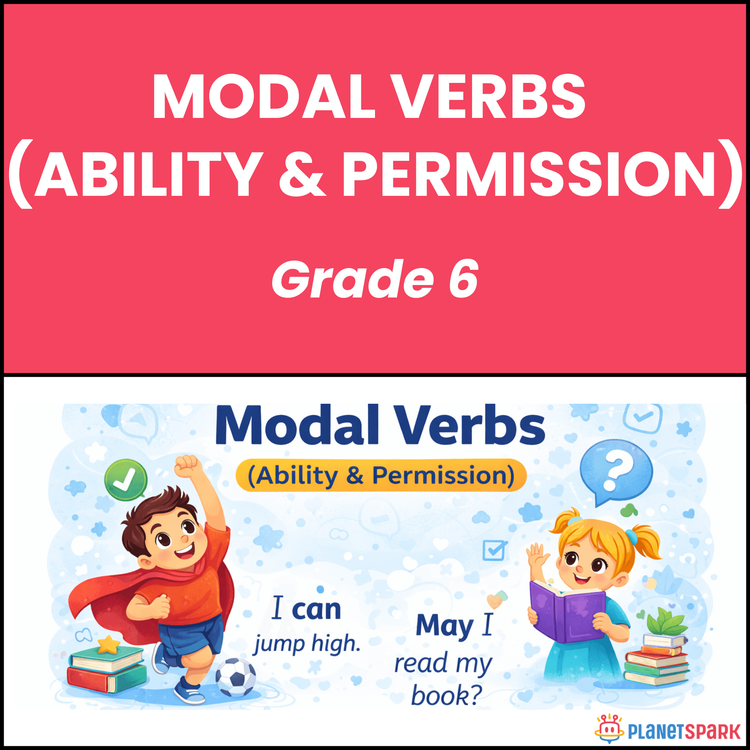
Class 6 Grammar Worksheet on Modal Verbs (Ability)
Modal Verbs (Ability & Permission) for Class 6: Enhancing Grammar Skills
This Grade 6 worksheet helps students understand and use modal verbs for expressing ability and permission. Through engaging exercises, students will learn how to use modals like can, could, may, and might to talk about what they can or are allowed to do. The worksheet includes underlining modal verbs in sentences, choosing the correct option, and rewriting sentences to apply modal verbs appropriately.
By completing this worksheet, students will:
- Learn how to use modal verbs for expressing ability (e.g., can, could).
- Understand how to use modal verbs for expressing permission (e.g., may).
- Improve their grammar by practicing with different modal verb structures in sentences.
Answer Key:
Exercise No. 1 – Underline the Modal Verb Showing Ability or Permission in Each Sentence:
- I can run fast in the race.
Modal Verb: can (Ability) - She could dance very gracefully last year.
Modal Verb: could (Ability) - You may borrow my book after you're done reading.
Modal Verb: may (Permission) - They could travel abroad when they were younger.
Modal Verb: could (Ability) - They may stay out until 8 PM.
Modal Verb: may (Permission) - You may join us for dinner.
Modal Verb: may (Permission) - We could play soccer if it stops raining.
Modal Verb: could (Ability) - He can write stories very quickly.
Modal Verb: can (Ability) - I can finish this homework in 30 minutes.
Modal Verb: can (Ability) - She can make delicious chocolate cake.
Modal Verb: can (Ability)
Exercise No. 2 – Choose the Correct Sentence:
- a) She can sing very well.
- a) They could swim when they were young.
- a) You may leave after the meeting.
- a) He can ride a bike.
- b) We may go to the park tomorrow.
- a) I could solve the problem easily.
- a) She can play the piano.
- a) They may attend the event.
- a) He can speak five languages.
- a) You may take a break now.
Exercise No. 3 – Apply the Rule to Rewrite Each Sentence Correctly:
- He knows how to ride a bike.
- They are able to sing in a choir.
- She is permitted to go to the event.
- You are allowed to leave after class.
- I finished my homework easily.
- We are allowed to take the day off.
- They have permission to stay at the party.
- I can understand five languages.
- He is able to play the guitar.
- You are able to take a break now.
Exercise No. 4 – Fill in the Blanks:
- can
- could
- may
- may
- can
- can
- may
- could
- may
- can
Exercise No. 5 – Sample Answer for Paragraph Writing:
At school, there are many things that I can do. I can participate in various activities such as singing in the choir and playing soccer during P.E. class. I am allowed to join clubs after school, and I may attend special events that the school organizes. Sometimes, I even get permission to use the computer in the library to work on my assignments. However, I am not allowed to leave the school premises during lunch, and I cannot stay late after school unless I have an activity. I enjoy being able to do many things, and I respect the rules that help keep us safe.
Help your child master the use of modal verbs for ability and permission with a fun and interactive grammar lesson.
Frequently Asked Questions
Modal verbs like "can" and "could" express the ability to do something, e.g., "I can swim."
By using "can" or "could" before the main verb, students can show their capabilities or limitations.
Modal verbs help students communicate their skills and abilities clearly and precisely.