
Class 5 Worksheet on Quotation Marks in Dialogue

Class 5 Worksheet on Quotation Marks in Dialogue
Speak with Clarity: Quotation Marks with Dialogue Tags for Class 5
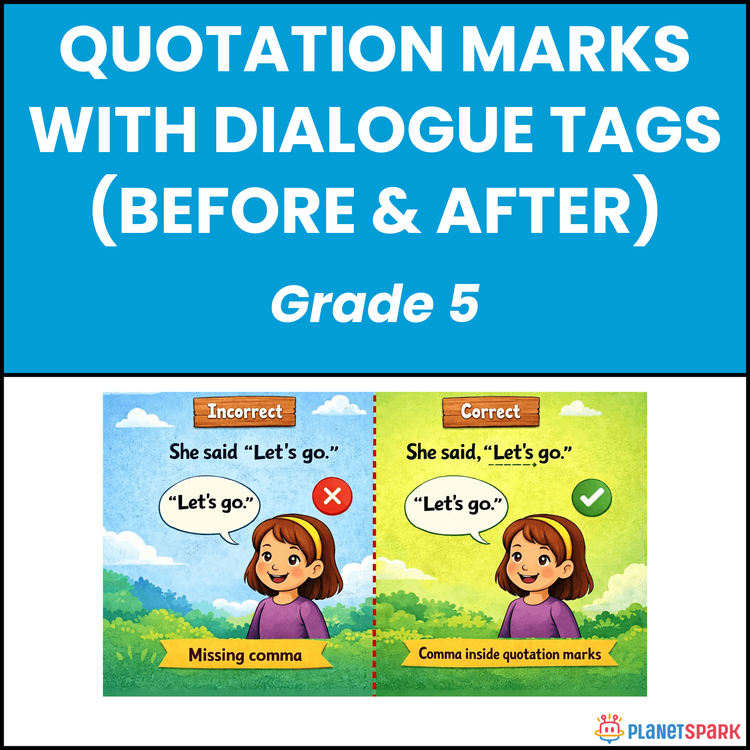
This Grade 5 worksheet focuses on mastering quotation marks with dialogue tags placed before and after speech. It helps learners understand how to punctuate spoken sentences correctly using commas, capital letters, and quotation marks. With engaging and structured activities, students learn to identify, correct, and create dialogue sentences with confidence.
Why Quotation Marks with Dialogue Tags Matter in Grammar?
Quotation marks help show exactly what someone is saying, making writing clearer and more expressive. For Grade 5 learners, this topic is important because:
1. It teaches correct punctuation in direct speech.
2. It improves sentence structure and clarity.
3. It builds strong writing and storytelling skills.
4. It helps students use commas and capital letters correctly in dialogue.
What’s Inside This Worksheet?
This worksheet includes five grammar-focused activities to build strong understanding of quotation marks with dialogue tags:
Exercise 1 – Multiple Choice Questions
Students choose the correctly punctuated sentence from three options. This helps them identify proper use of commas, quotation marks, and capitalization in dialogue.
Exercise 2 – True or False
Students read each sentence and decide whether quotation marks and punctuation are used correctly. This sharpens error detection skills.
Exercise 3 – Fill in the Blanks
Students add suitable quotation marks and commas to complete dialogue sentences. This reinforces correct punctuation patterns.
Exercise 4 – Sentence Rewriting
Students replace simple dialogue tags like “says” with more expressive words such as replies, exclaims, or declares. This builds vocabulary and improves sentence variety.
Exercise 5 – Paragraph Writing with Punctuation
Students read a short paragraph and fill in missing punctuation in dialogue. This activity builds real-life application and comprehension.
Help your child master dialogue punctuation and express ideas clearly in writing with this engaging worksheet.
Answer Key (For Parents & Educators)
Exercise 1 – Multiple Choice Questions
1. a
2. b
3. b
4. a
5. a
6. c
7. b
8. b
9. b
10. a
Exercise 2 – True or False
1. True
2. True
3. True
4. True
5. False
6. True
7. True
8. True
9. True
10. True
Exercise 3 – Fill in the Blanks
1. Riya said, "I am ready."
2. Ravi said, "Let us start."
3. Meera said, "We will win."
4. Raj said, "I finished my work."
5. Asha said, "This is fun."
6. The teacher said, "Open your books."
7. Ravi said, "Let us play."
8. The teacher said, "Be quiet."
9. Meera said, "We are best friends."
10. Riya said, "I finished my homework."
Exercise 4 – Sentence Rewriting (Sample Answers)
1. Riya replies, "I am ready."
2. Meera declares, "We will win."
3. Raj states, "I finished my work."
4. Ravi adds, "Let us start."
5. Asha exclaims, "This is fun."
6. The teacher remarks, "Open your books."
7. Ravi replies, "Let us play."
8. The teacher declares, "Be quiet."
9. Meera states, "We are best friends."
10. Riya adds, "I finished my homework."
Exercise 5 – Paragraph Writing
She said, "Open your books."
"I have found the page," Riya answered.
"Shall we read together?" Ravi said.
Frequently Asked Questions
Quotation marks show the exact words a character or speaker says in a story or conversation.
Periods and commas go inside quotation marks, while question marks depend on the sentence structure.
Practice reading aloud, mark spoken words with quotes, and check punctuation placement consistently in sentences.